
The CFO Bridge · Issue #1 · April 30, 2026
Finance Is Drowning.
A CFO playbook for stabilizing the finance function without waiting for the perfect answer.
In the last two weeks, I had versions of the same conversation with an investor, a CFO at a sponsor-backed portfolio company, and the CEO of a data business.
The details were different, but the finance issue was familiar. The team was working hard, but too many important answers still depended on the same few people rebuilding data by hand.
In one conversation, the CFO walked through the week: close work, board prep, forecast updates, segment profitability & restructuring questions, and Sponsor + CEO requests all landed on the same few people. Each request made sense on its own, but together they left no slack. The team had already lost people, and the next resignation was about to take more institutional knowledge with it.
The question he posed was natural: who do we need to hire?
But I didn't think that was the right question right then. Before adding permanent headcount, the CFO needs a work restructuring plan: the reports to stop, the data problems creating rework, the work that needs temporary / surge help, and the capabilities the company needs for its next stage of growth.
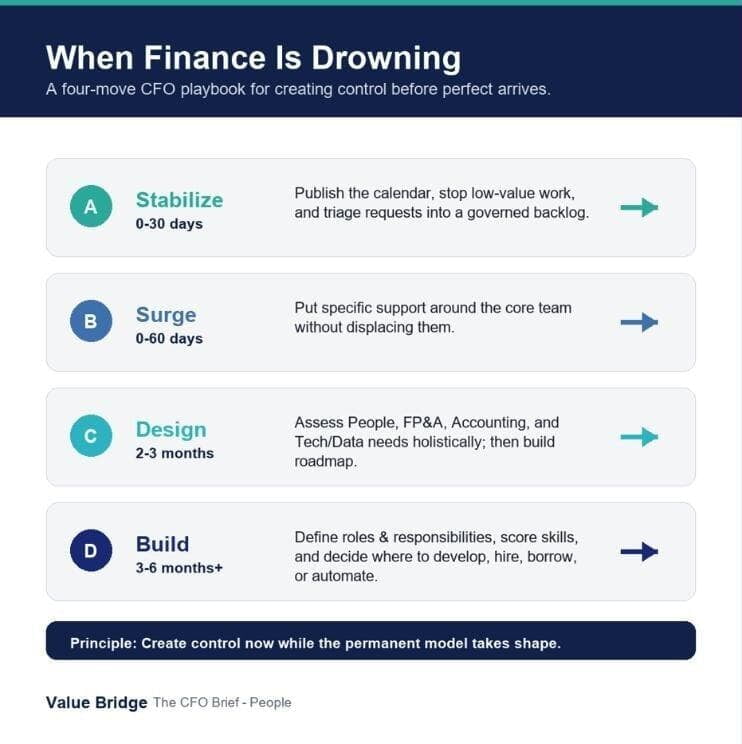
If you hire into unclear work or ad-hoc / manual processes, new headcount inherits inefficient processes, duplicated work, weak data, and the same system gaps. The better path has four moves:
- Stabilize the work,
- Add expert Surge capacity around the team,
- Design the finance capabilities the company needs next, and
- Build the long-term team around the work you have clarified.
1. Stabilize: Create capacity in the first 30 days
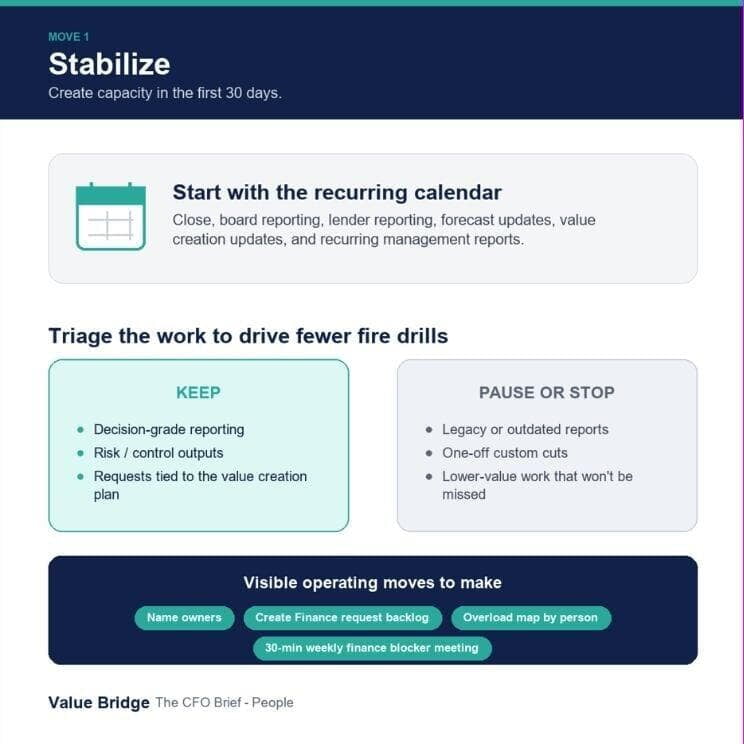
I would start by asking the CFO to set the recurring finance calendar: close, board reporting, lender reporting, forecast updates, value creation updates, and recurring management reports.
Next, work with the finance team, CEO, sponsor, and leadership team to separate finance work into two groups: outputs that drive decisions or control risk, and outputs that survive through habit.
That exercise often exposes an inventory of legacy reports, needlessly complex forecasts, custom cuts, and ad-hoc requests. Of course, you will also get new requests that are needed for the changing business landscape.
Pause the work no one will miss, and create control & triage the business partner needs through a few visible moves:
- Publish a close/Accounting calendar, and reporting / FP&A calendar with named owners for each output.
- Move finance requests out of inboxes and into a visible backlog the CEO / CFO reviews each week.
- Identify the people who appear on the most deliverables and decide which work must move off their plate.
- Run one 30-minute operating meeting each week covering close status, cash, forecast, and key finance deliverable blockers.
Stabilization gives the team enough capacity to stop reacting to every request as a fire drill.
2. Surge: Add capacity without displacing the team ("Interim ++")
Most strained finance teams need help before they can improve themselves. Sponsors and CEOs sometimes hesitate because outside support can look like a vote of no confidence in the current team. Frame it as protection.
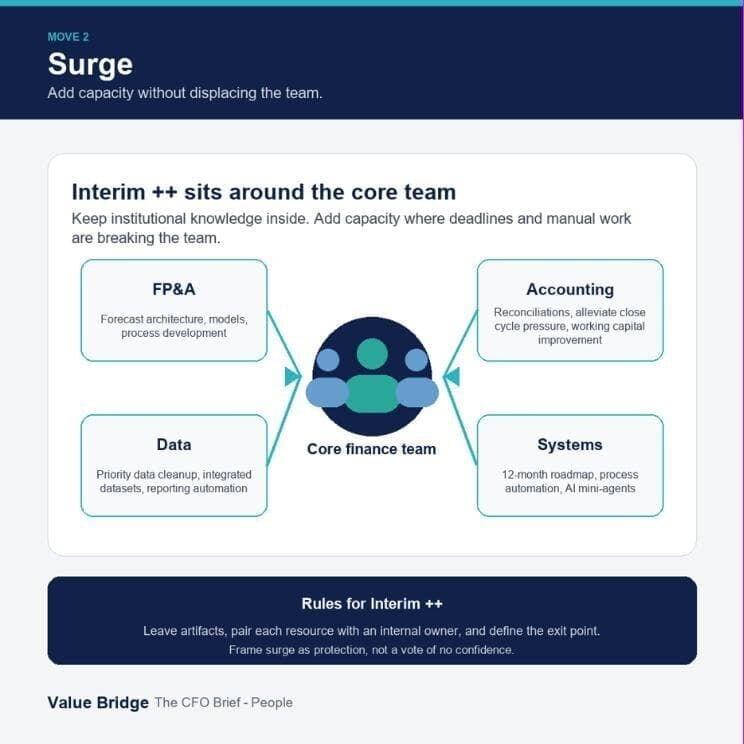
Surge support should sit around the core team. The company keeps institutional knowledge inside while adding capacity for the work the team cannot absorb, or for deadlines that must be met.
Useful interim roles include:
- An FP&A associate or manager to rebuild the forecast architecture, models and processes prior to training the internal analysts
- An interim controller or accounting support to reduce close cycle pressure, working capital experts
- A data analyst to clean up priority data issues and stand up quick integration of various system-generated information
- A finance systems lead to scope the next 12 months of system work, define automation opportunities, develop mini-agents for Finance
Two rules make surge / interim support work. Each interim resource must leave behind artifacts the permanent team can own: a documented process, templatized / structured models or tools, clear instructions, and automated workflows (especially AI-driven task-specific skills or mini-agents). Each interim resource also needs a named internal partner and a defined exit point.
Those rules keep surge support from becoming unplanned fixed cost. Each resource becomes a bridge from firefighting to a finance function the company can scale.
For sponsors and executives, the math works in many cases. Three to six months of interim finance support costs less than business disruptions, a revolving door in the Finance department, or missed critical work (lender reporting, business insights, or subpar exit processes).
3. Design the Finance function end-state: move from heroics to capability building
Once the team has capacity and support with clearly defined goals and deliverables, the CFO can address the capability gaps underneath the symptoms.
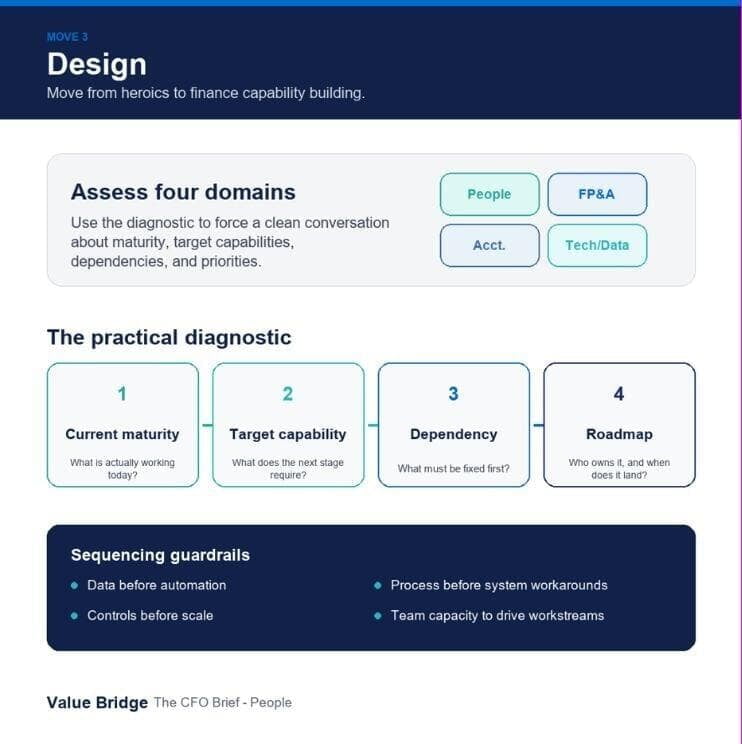
I assess the finance function across four domains: People, FP&A, Accounting, and Technology / Data. This structured approach forces the leadership team to understand current maturity levels, target specific capabilities for development, highlights inter-dependencies, and gaps that could slow the broader business value creation plan.
The diagnostic should answer six practical questions:
- Identify the processes or capabilities that create the most risk if they remain broken.
- Define the fixes with the strongest benefit-vs-cost, and with rapid speed-to-value.
- Rank the improvements by business value + achievement speed.
- Find the changes that require scarce team capacity, or with missing internal capabilities.
- Flag the dependencies that block the work.
- Construct a roadmap with internal and external resources and specific milestones.
The order of work matters. A company should clean master data and fix the capture of information before automating workflows that consume it. System workarounds should not be used if the processes are fundamentally not well designed. Controls should be defined before scaling high-risk processes.
Sponsors and CFOs also need to sequence work against the team's absorption capacity. A team still closing the prior month on business day 15 cannot absorb three transformation workstreams. Fund the Finance standup / transformation, pick the highest-value work, and make the leadership team live with tradeoffs.
For many middle-market companies, meaningful progress can happen in 3 to 6 months if the work has funding, ownership, and logical sequencing. The goal is a finance function that closes on a predictable cadence, forecasts with enough accuracy to guide decisions, reports with decision-grade clarity, and supports the business without manual heroics.
Mistakes to avoid
Several common moves make the problem worse:
- Treating finance as an unlimited request desk
- Buying a new ERP before the company defines the processes it wants the system to run
- Automating "messy" / "dirty" customer, sales, product, revenue, or headcount data
- Hiring permanent roles against emergency work instead of clarified & prioritized work
- Loading transformation projects onto a team still struggling to close and report
The CFO has to protect the function from well-intended demand. Sponsors can help by aligning on the prioritization at the board and leadership level (and living by their decisions!).
4. Build: design the long-term team around the end-state work
Start role design during stabilization. Lock the permanent model after you know which work should remain in finance, move to the business, get outsourced, or disappear from the Finance roadmap.
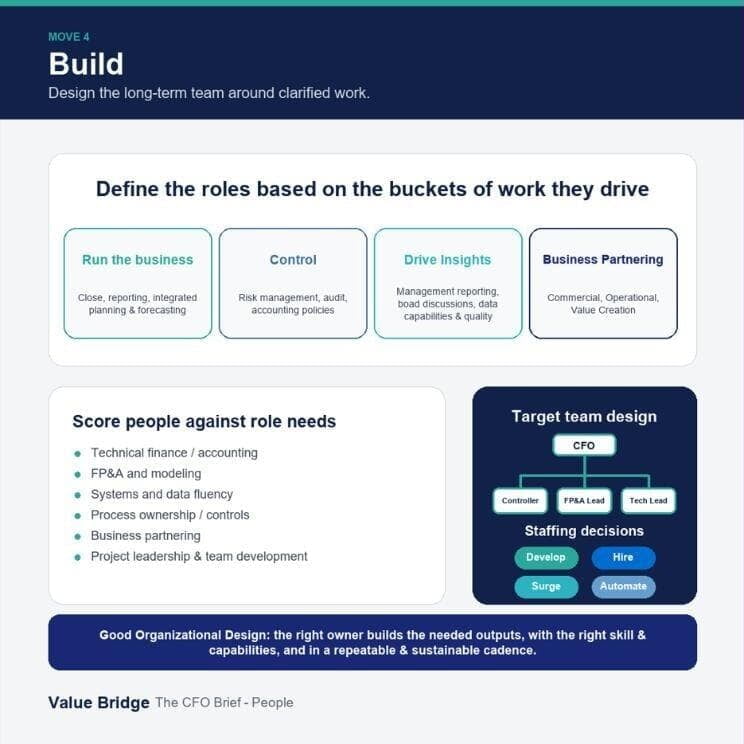
Organization design starts with the work. Most finance activity falls into four buckets: run the finance processes needed by business, control risk, improve the business insights, and partner with business leaders to drive value creation. From there, define the seats and the capabilities needed to be successful in each bucket.
Smaller or resource-constrained companies may not be able to get to the permanent design right away, there will be trade-offs such as combining roles or trading off better performance in one sub-area for another.
The harder step is grading the team against the work. Many CFOs evaluate people through a vague mix of "good," "trusted," and "knows the business." A better review scores the skills the role requires against specific dimensions.
The dimensions I think about include:
- Technical finance and accounting knowledge
- FP&A and modeling capability
- Systems and data fluency
- Process ownership and controls mindset
- Business partnering and executive communication
- Project leadership and team development
A high-performing FP&A lead example makes the difference clear. An FP&A lead that builds template-based budgets, compiles the sales forecast, and writes variance commentary that describes the past is not driving the insights needed for the business. A capable FP&A lead runs driver-based reforecasts, pressure-tests pipeline assumptions, ties variance commentary to operating decisions, and communicates it back to business leaders. A transformative FP&A lead owns connected planning, builds CEO-ready scenarios in hours, works with commercial leaders on pricing and deal structure, and with operations on headcount efficiencies, truly driving business outcomes.
Once you score roles this way, the staffing plan should become specific. One gap may close through a 90-day development plan, while another may require a replacement hire. Another may need interim support until the company can automate or redesign the work.
The long-term team is ready when the right work has the right owner, skill level, and cadence.
A short cheat-sheet for CFOs and sponsors
Do this to design an actionable plan before the next board meeting:
- Name the single points of failure by person and output.
- List the deliverables that would break if those people left next month.
- Rank deliverables by time consumed and decision value.
- Identify gaps that would surface in the audit, board discussions, or exit diligence.
- Identify the outputs causing the most rework or noise around the organization (e.g., messy data).
- Tie each missing capability to the "must-do" work or the value creation plan-related work.
- Pick the fixes that can land inside 30–60 days.
In a sponsor-backed company, finance underinvestment compounds. Each quarter of unsustainable load increases business risk, weakens board confidence, slows board decision-making, and ultimately leads to a change in the CFO.
Sponsors improve outcomes when they align on sequencing the work, fund the improvement, and are realistic about the goals and the time needed to close the gaps.
The companies that handle this well stop waiting for the perfect plan, hire, or system. They create control now, add capacity where the team is breaking, build the finance capabilities that matter, and design the permanent team around clarified work.
Working through this at a portfolio company? Talk to us. More issues: Insights · Read on LinkedIn.