The CFO Bridge · June 24, 2026
Sales Is Scaling Faster Than RevOps.
A CFO playbook for building trust in pipeline, ARR, and forecasts before the board loses confidence.
Over the past two months, I've had versions of the same conversation with a sponsor, a Head of Sales, and two CFOs at private equity-backed companies.
The details were different, but the core problem was the same. The company was growing and hiring, yet leadership could not produce one trusted view of pipeline, bookings, ARR, and the forecast without people rebuilding it by hand, with heavy input and back and forth from finance, sales teams and managers.
You can see it in a single meeting. The CFO, Head of Sales / Chief Revenue Officer ("CRO"), and CEO sit down for the weekly or monthly business review conversation and arrive with three different perspectives. The CRO has a pipeline view from the CRM. Finance has an ARR bridge and a cash forecast. The CEO has the strategic plan and key client and product context. But the numbers don't tie and there are holes in hitting the projections.
No one is being careless. The company has scaled faster than the revenue operating system underneath it.
I have watched this happen as a sales team grows from three AEs to a dozen in a couple of quarters. At three reps, the company runs on tribal knowledge. At twelve, tribal knowledge becomes a revenue risk. The CRM was built for a smaller team. The Head of Sales / CRO still hand-builds parts of the weekly report. The reporting Excel workbook holds revenue data sourced directly from the ERP, but it doesn't match the CRM. Sales incentive plans are still being figured out. Bookings, Backlog, Recurring Revenue, Revenue, Commissions, Renewals, and Contract Value do not reconcile cleanly enough for the CFO to use in a board pack.
The natural question around the table: how can we get better visibility and improve sales reporting?
That question is only partially correct. A better reporting dashboard will expose the problem faster, but, before adding reports, the CFO needs a deliberate plan for where Revenue / Go-to-Market Operations ("RevOps") is today and where it has to go.
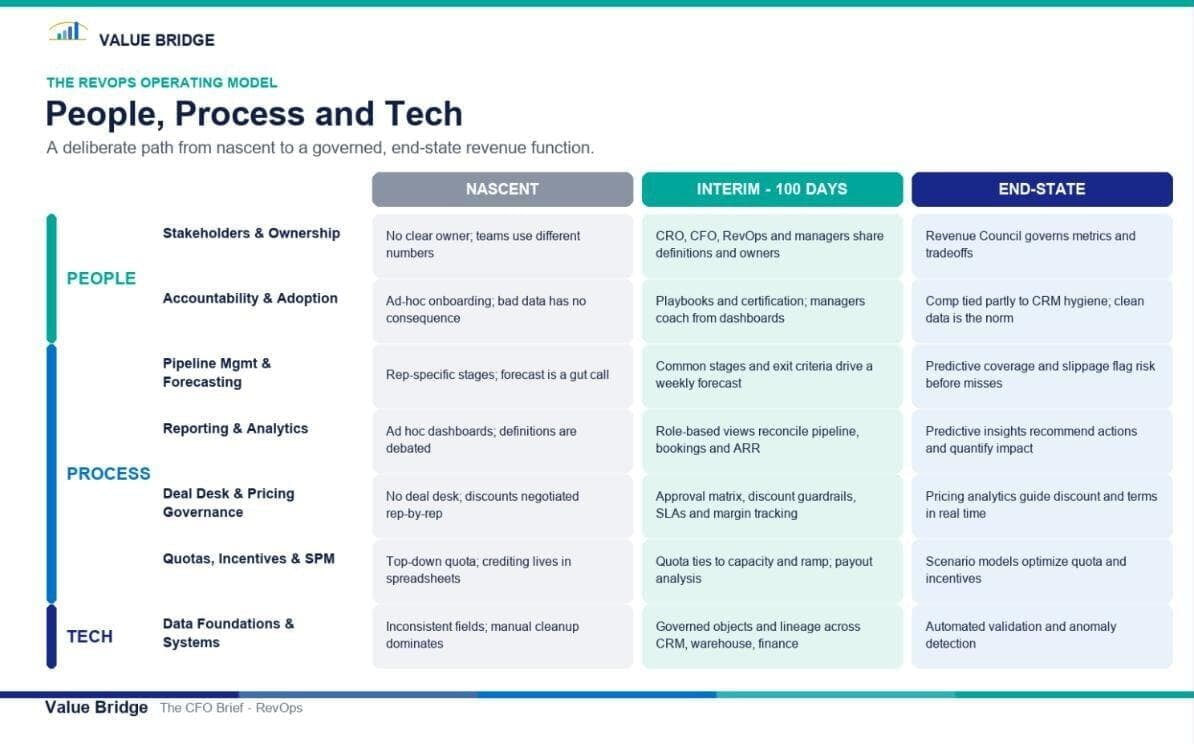
I build RevOps capabilities across three domains (People, Process, and Tech and Data) and sequence the fixes across two stages: the first 100 days that move the function from nascent to a working interim state, and the scaling phase that takes it to end-state.
The key priority for these fixes is not to focus on systems only. The focus should be on smaller moves that develop capabilities to produce high quality insights (reporting, forecasting) and efficient go to market outcomes (pricing management & deal-desks, sales incentive plans).
This path has three moves, sequenced over time from the first 100 days to the end-state:
- People: agree who owns each revenue value lever, across Sales, Customer Success & Ops, and Finance.
- Process: govern how deals move through the pipeline, how pricing is controlled, and how reps are paid.
- Tech and data: build a revenue data set everyone can trust and use to understand current performance and forecasting.
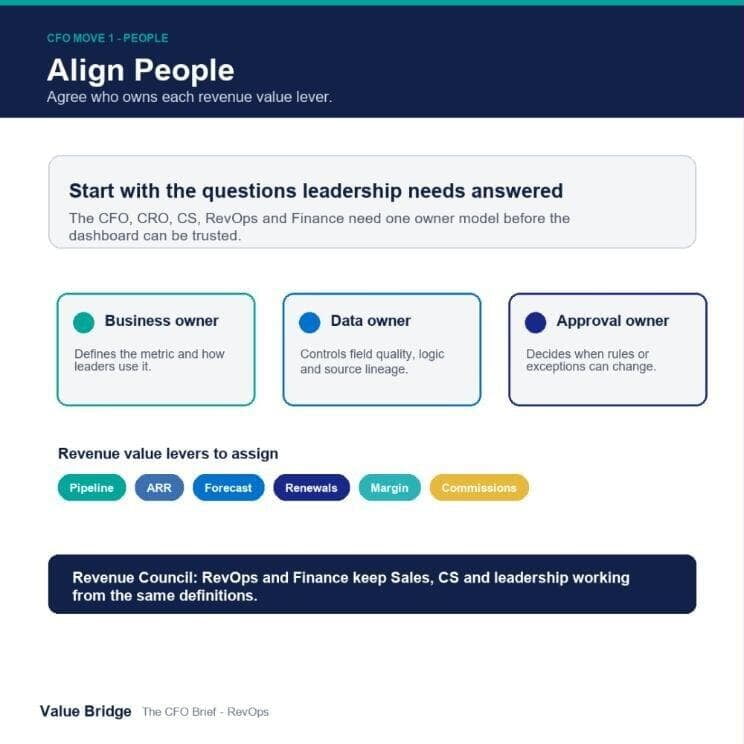
CFO Move 1. Align People: agree who owns each revenue value lever
Start with the people before the tooling.
Most RevOps problems look like data problems because no one has agreed what business questions / actions the data is supposed to drive. The CFO wants ARR, revenue, cash, and commission exposure. The CRO wants pipeline, coverage, commit, productivity, and deal risk. Customer Success wants renewal, expansion, health, and handoff visibility. The CEO and sponsor want the board story and results.
In the first week, I would ask the CFO and CRO to name the five to seven revenue questions leadership must answer every week:
- Are we creating enough qualified pipeline by segment and source?
- Which commit deals changed, and why?
- How do bookings, ARR, revenue, billing, and cash tie together?
- Where are renewal, expansion, discount, or margin risks emerging?
- Which managers, reps, products, or segments need action before the quarter slips?
- What care / caveats should leadership use when making decisions until the data is fixed?
Then name an owner for each answer. The business owner decides what the metric means and how it will be used. A data owner controls the system logic and field quality. An approval owner decides when definitions, rules, or exceptions can change. The responsibility of RevOps (and the CFO) is to drive this alignment and build the supporting people engine.
Ownership only holds if adoption has consequences. In a nascent RevOps function, reps learn the system by osmosis and bad data costs nothing. That has to change: managers coach from the dashboard rather than a side spreadsheet, exceptions should get resolved at the source, and variable comp is tied partly to CRM hygiene so clean data is a paid expectation, not a favor.
This is also where the governing forum lives. A Revenue Council, driven by RevOps and Finance, governs metric definitions, adoption, and tradeoffs across GTM and Finance. It is the body that keeps revenue truth from changing depending on who exported the report.
The CFO and Finance can do all of this without becoming the CRM administrator. Leave field ownership with the right operators, and insist that every number used in a board pack has an owner, a source, a definition, and a review cadence.
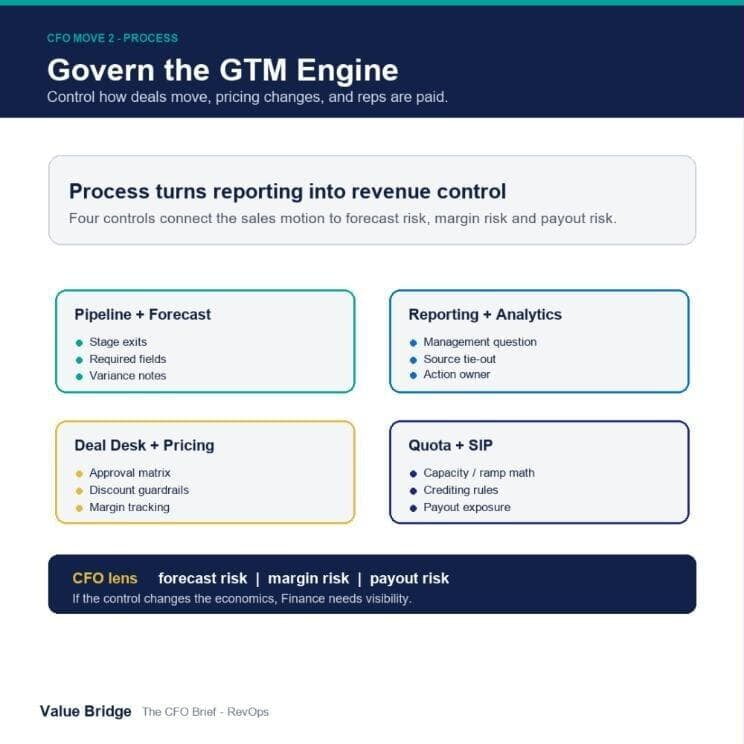
CFO Move 2. Process: govern how deals move, how pricing is controlled, and how reps are paid
Process is where RevOps stops being reporting and starts being control over the GtM engine. Four pieces matter, and the last two are finance controls that often get mislabeled as sales administration:
- Pipeline and forecasting: Replace rep-specific stages and gut-feel calls with common stages, written exit criteria, and required fields. Run a weekly forecast with commit, best-case, and pipeline categories, and track accuracy over time. The weekly review should separate deal opinion from deal evidence: what changed, why it changed, who owns the next action, and whether the change affects forecast confidence. Snapshot the forecast each week so the team can see how commit moved, where upside disappeared, and which managers were accurate, instead of reconstructing the quarter from memory.
- Reporting and analytics: Start with the management question, then work backward to the fields, source systems, process changes, and behavior needed to answer it. That is the fastest lever for fixing the underlying data. Build role-based CRO, CFO, and CEO views that reconcile pipeline, bookings, ARR, and retention rather than dashboards where users debate definitions. The CFO should ask three questions of every report: What decision does this support? Who owns the action when the number changes? Can Finance tie the number back to the plan, ARR bridge, revenue, billing, cash, or commission logic? If the answer is no, the report is not an operating tool yet. It is just a visualization of an unfinished process.
- Deal desk and pricing governance: Without a deal desk; pricing, discounts, and non-standard terms get negotiated rep by rep with no approval thresholds. Stand up an approval matrix, discount guardrails, and SLAs for non-standard terms, with margin and concession tracking. This is a finance-critical control: it decides who can give margin away, how exceptions are logged, and how Finance sees the impact in forecast, ARR, revenue, and cash. FP&A should play a critical role in understanding trends here so market pricing feedback can be reflected and pricing strategy can be appropriately tailored.
- Sales Quotas, Incentives, and Sales Performance: When quota is set top-down with no capacity math, and crediting logic lives in spreadsheets, the plan has a high degree of forecast, margin, and payout risk. Tie quota allocation to capacity, ramp, territory, and segment drivers. Document crediting rules, accelerators, and exceptions, and track attainment and payout exposure comprehensively. Institute a quota allocation model that tracks initial assumption around quota attainment and ongoing performance against it, at a granular level (e.g. individual rep, team, or segment). Also use the data in the quota model to understand performance and align it to a sales incentive plan that has the appropriate incentives for new clients, new product / service expansion or upsell, retention and related modifiers / accelerators.
CFO Move 3. Tech and data: build one revenue model everyone can trust
People and process tell you what the numbers mean and what has to be done. The data foundation decides whether the systems can actually produce them.
To fix it:
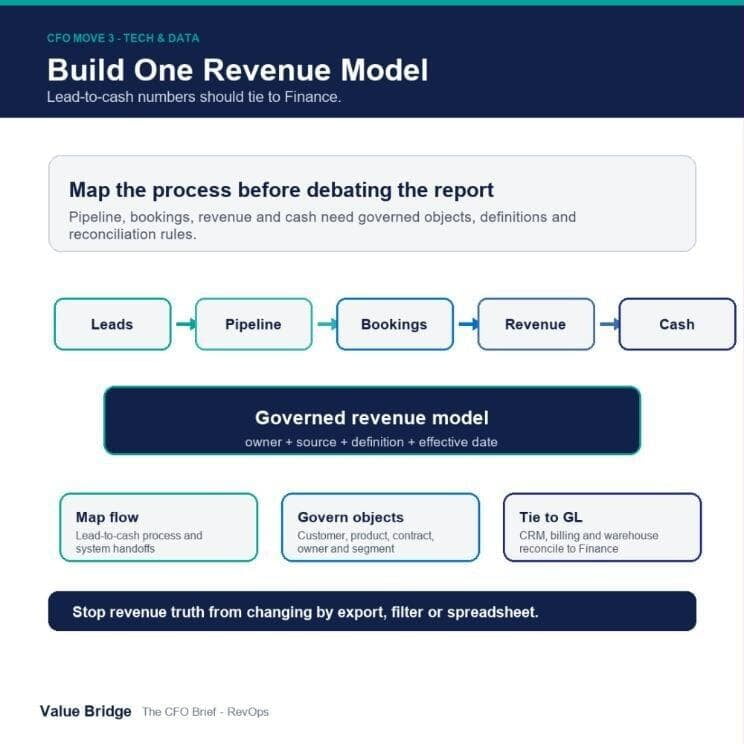
Map the revenue data and related process flow across systems first "Lead to Cash": marketing leads to pipeline to bookings, bookings to revenue, and revenue to cash. This mapping almost always surfaces the same issues:
- CRM opportunity stages do not map cleanly to forecast categories.
- Bookings definitions are not consistently applied, contract values are not properly split (recurring vs non-recurring), and do not match commissionable credit.
- ARR / revenue movement cannot be tied cleanly to contracts, billing, or renewal data, often due to inconsistent use of contract lineage, issues with product, or customer masters, or undefined logic around upsell / downsell / churn.
- Close dates, next steps, buyer roles, and renewal-risk fields are stale or missing.
- CRM, billing, ERP, warehouse, CS, and Finance reports use different timing, filters, or exception rules.
Define and govern the objects that make the numbers usable: account and customer hierarchy, opportunity fields, product mapping, contract terms, billing identifiers, territory, segment, owner, source, and renewal dates.
Pair the above with a metric dictionary for the revenue numbers used in the forecast and board pack, an effective-date policy so teams do not rewrite history when a definition changes, and a decision log for metric, stage, quota, and exceptions.
What to stand up in the first 100 days
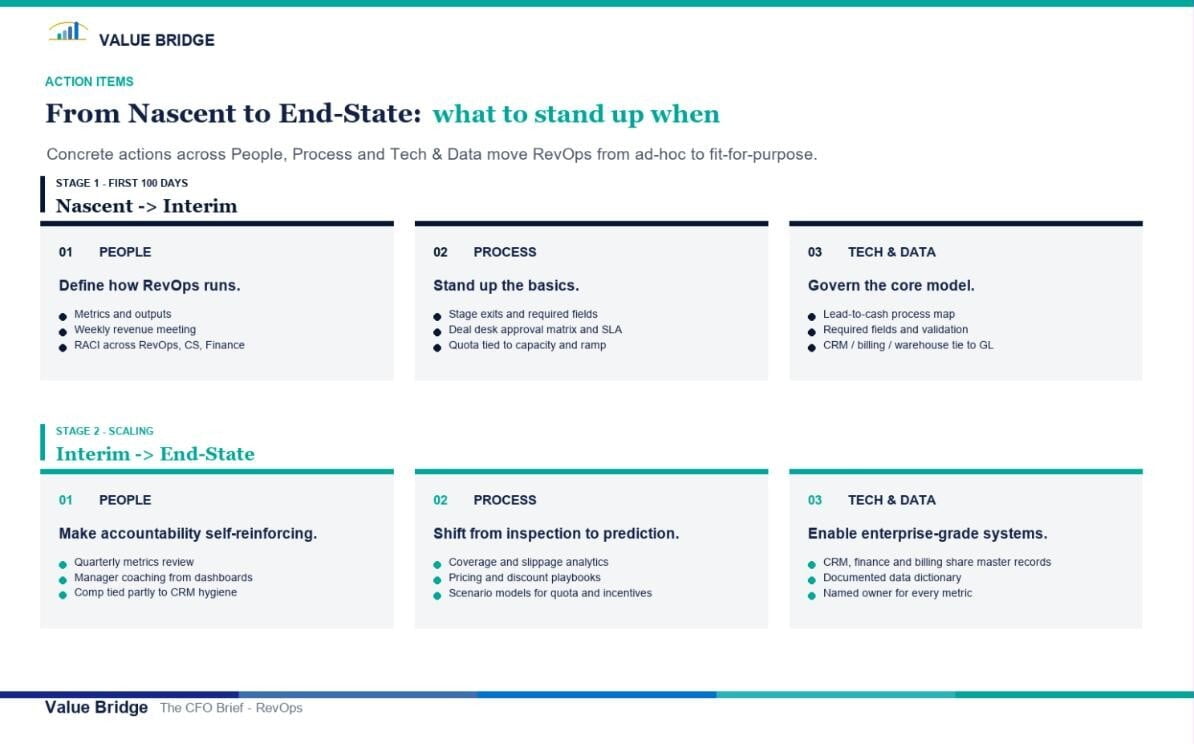
The first 100 days should not become a full RevOps transformation. It should move the function from nascent to a working interim state, organized across the same three domains.
Following the key goals above, do this:
- People: work with the CEO, CFO, and CRO to define the key metrics and outputs, launch the weekly revenue meeting covering pipeline, forecast, and data quality, and publish a RACI across RevOps, CS, and Finance.
- Process: define sales stages with written exit criteria and required fields, stand up a deal desk with an approval matrix and SLA, tie quotas to capacity and ramp, and run a weekly forecast routine with variance notes.
- Tech and data: map the process and related data from the target metrics, define gaps in required fields and validation rules, and reconcile CRM, billing, and data warehouse output to the GL.
This is the practical difference between reporting and revenue control. A dashboard can show discounting is rising. A governed control tells the company who approves discounting, what margin threshold applies, how exceptions are logged, whether the incentive plan rewards the behavior, and how Finance sees the impact in forecast, ARR, revenue, and cash.
What end-state looks like
The scaling phase moves the function from interim to end-state. The operating rhythm should be radically different once the data is trusted and the cadence is owned:
- The CRO and CFO open the same dashboard. Commit, best-case, and coverage reconcile without a pre-meeting, and managers walk in with the same numbers leadership is reading.
- The deal desk clears quickly. Reps know the approval path, pricing exceptions are logged and tracked, and legal and finance see one queue.
- Managers coach AEs from one scorecard (hygiene, conversion, ramp, and attainment from a single source) with no spreadsheets reconciled the night before.
- Board packs tie bookings, ARR, retention, and pipeline back to the GL and the CRM. Variance is explained, not reconstructed, and the board hears the same story Finance and revenue tell internally.
Mistakes to avoid
Several common moves make the problem worse:
- Treating RevOps as a CRM ticket desk instead of a revenue operating function.
- Building dashboards before settling people, process, data ownership, and source-of-truth rules.
- Letting the CRO and CFO work from different bookings, ARR, or pipeline numbers.
- Treating deal desk, pricing, quota, and incentive governance as sales administration rather than finance-critical controls.
- Automating dirty CRM data before managers trust and enforce the process.
- Launching AI summaries, scoring, or forecast tools before the company has clean definitions and human review rules.
The CFO has to protect the company from a familiar trap: confusing more reporting with more control. Reporting can expose the problem. The revenue operating layer creates the control for the business.
A short cheat-sheet for CFOs and sponsors
Do this before the next board cycle:
- Ask the CRO to name the five critical revenue related questions leadership must answer every week that do not work, or require a lot of work.
- Map each answer to a stakeholder owner, source system, and data owner.
- Compare CRM pipeline, bookings, ARR, revenue, and billing data across systems to surface variances & reconciliation issues.
- Scan deal-desk, pricing exceptions, and payout / SIP exceptions for margin / payout risk being created outside Finance visibility or controls.
- Pick the fixes that can land inside 30 to 60 days.
In a sponsor-backed company, revenue-related underinvestment compounds. Each quarter with weak RevOps makes the forecast harder to defend, the board pack harder to trust, and the growth value creation plan harder to manage.
Sponsors can improve outcomes by funding the operating layer early: stakeholder alignment, process governance, a trusted data model, and a clear path to permanent RevOps ownership. CFOs can improve outcomes when they treat revenue data with the same seriousness they bring to close, cash, and reporting.
The companies that handle this well move before the perfect dashboard, system, or hire arrives. They build the RevOps operating model across people, process, and tech, and sequence it from the first 100 days to end-state.
That is how the next stage of sales growth stops outrunning the controls needed to manage it.
Working through this at a portfolio company? Talk to us. More issues: Insights · Read on LinkedIn.